>>I am brazilian and I speak portuguese, so forgive my english, I’ll use translation tools to help<<
INTRO:
As promised in the FiiO JT1 review, now it’s time to the HIFIMAN HE400se. HIFIMAN needs no introduction, it has already become one of the most famous Chinese companies in the field of headphones and certainly planar magnetic headphones. The company has a vast catalog of headphones available, the HE400se is just one of the brand’s entry-level headphones.
At the moment, there are two versions of the HE400se being sold on AliExpress: Version 1 which is Bilateral magnets, and version 2 which is Stealth magnets. I’m going to review is version 1. The official price of the headphone is currently published by HIFIMAN for $109.99, but it’s now possible to find the product at much lower prices than the official price.
Price: $109.99 USD
Color: Black/Silver
HIFIMAN LINKS:
https://s.click.aliexpress.com/e/_DdCKqe7 (official store)
SPECIFICATIONS:
– Open-back Over-ear Headphones
– (1) Planar Magnetic Driver per side
– Frequency range: 20Hz – 20kHz
– Impedance: 25Ω
– Sensitivity: 91dB
– Connectors: 3.5mm (detachable)
– Plug: 3.5mm (L design)
– Cable material: rubberized copper
– Cable size: about 150cm
– Adapter 3.5mm female to 6.35mm male
– Headphone weight: 387.5g (without cable)
– Cable weight: 49.2g
– Total weight (box, headphones, etc): 805.2g
– Packaging size: 26cm [H] x 23.5cm [W] x 13cm [D]
UNBOXING:
PHYSICAL ASPECTS:
Construction: If you saw it in the introduction paragraph, there’s no way not to contextualize the current price of this product with the construction it offers. It’s a planar magnetic headphone for less than $100 usd, one of the best-selling headphones in the hobby, the bang for the buck is unbelievable. It has a metal structure that comes out of the arches and fits into the shells using a screw, the shells are made of plastic painted in a metallic color, the side grids and where the names “HIFIMAN”, “HE400se”, also they are a plastic part.
The headphone’s packaging has undergone some changes over time, now, things are much more basic, without much refinement, just a cardboard box with a sticker. At least, the positive side is that the company sends the headphone wrapped in foam that already serves as a stand for the headphone… exactly, it was designed for that very reason, I thought the idea was brilliant, the person doesn’t even need to spend extra on a stand. Of course, it’s a low-cost stand, but it’s better than leaving the headphones on anyway. It’s possible that not every package comes with this stand, so please, attention.
Headband: I thought the headband was very good, it has a lot of foam, but the arche of the headphone is thin, so it has that feeling that the weight is all in one point on the head. In this case, the weight distribution on the FiiO JT1 I found to be better. It’s not that the 400se is bad, it’s just that this headband format is kind of out of favor these days.
Pads: The 400se’s pads are better than those of the FiiO JT1, they have two types of material: synthetic leather on the outside, and also fabric on the part that comes into contact with the skin. Here on the 400se, the Pads are already much larger than the JT1, so much so that there was more space for my ears, but it’s better to have more space than to be touching the ear. They are very comfortable, I have nothing to complain about, they have good quality foam, very soft. The Pads are removable, but I couldn’t remove them, they didn’t come off easily and I decided not to force them for fear of damaging the product, however, I know from friends who have already replaced the Pads and it worked.
Something I didn’t like about the headphone was the size adjustment system… without a doubt it was the most negative point I found in the construction of the product. I’m not even going to waste time trying to explain what the system is like, it’s just that it doesn’t have the necessary strength to hold the stems, and then the shells end up coming down very easily. Any touch I give in the shells makes the stems come down. And another thing, the stems have a detail where you can change the angle of the shells, this can even be seen as a positive point, because it creates a more anatomical adjustment, however, the way it was implemented here is what I thought was bad, it left the structure is loose and kind of wobbles. It brings that feeling of a cheap product, which keeps shaking and making noise.
Cable: The HE400se cable can be removed, and it has P2 plugs (3.5mm) at all 3 ends. It’s a good cable, very robust, it has a rubberized coating that is very pleasant to the touch. The part that I don’t like is the weight, and also this rubberized material gives me the impression that it could resect and break (as happened with another headphone from a well-known brand…). I think there is the possibility of a cable upgrade here on this headphone.
Here I must need to mention and recommend the balanced cable that I’m using at the moment, I found it to be much better than the original. It’s the balanced OpenHeart 4.4mm, it’s lighter, thinner, and has better malleability than the cable that comes with the 400se… and isn’t expensive. So, here’s a good recommendation for anyone looking for a balanced cable at an affordable price.
Fit and comfort: First, as always, to say that this part is something very subjective, and second, that I come from experience with IEMs precisely because I think that comfort with headphones is less than with IEMs (at least I haven’t tested a headphone yet that makes me as comfortable as with an IEM). The Pads and Headband of the 400se are very comfortable, but the headphone as a whole doesn’t feel that comfortable… that’s because it’s not such a light headphone, for me the FiiO JT1 already has a feeling of being lighter … and there’s also the issue of size, unfortunately it is an object that I consider too big for my head. The clamping of the 400se on my head was practically zero, so much so that the headphone is loose for me, my head is small. If I shake my head, I feel like the headphone is likely to move out of its original position.
An important detail that you need to remember… The headphone has an open-back structure, and inevitably in this type of headphone, the sound ends up leaking a lot to the outside (surrounding environment). It’s like a speaker, but we forget that the sound is propagating… so, you can’t use this type of headphone anywhere, at least in my opinion, no… by e.g., in the streets, people will literally hear what you are listening to… at home at a later time it will be as if you were listening to loud music… in a library, no way! And another thing, external sounds can also enter in your listening more easily.
Accessories: There isn’t much to point out, it only comes with the 3.5mm to 6.35mm adapter, and the foam stand that comes in the box (if we can consider it as an accessory).


SOUND ASPECTS:
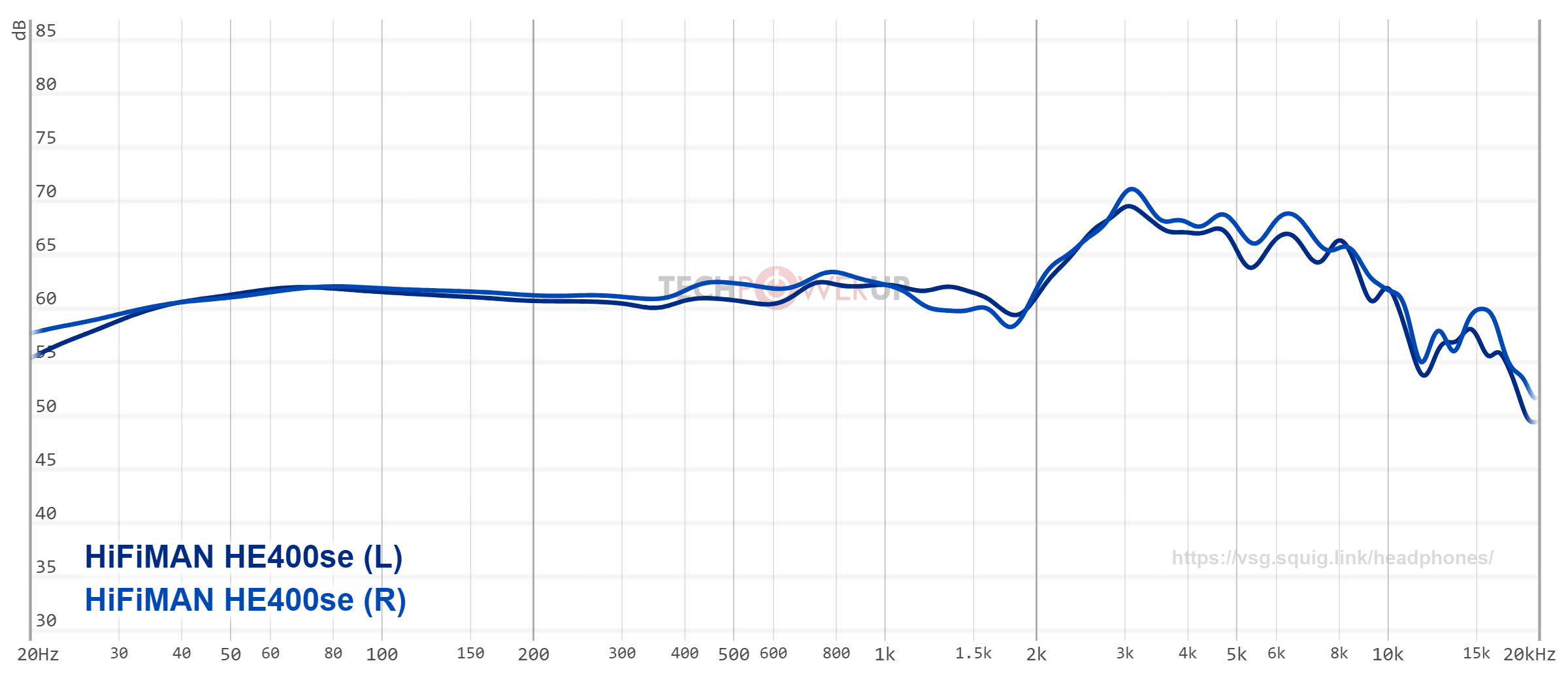
I consider the sound of the HIFIMAN HE400se to be Neutral-Bright. It’s true that the word “bright” may sound too strong for the occasion, someone could interpret it as if the headphone had too much treble, and that’s not the case… the thing is more because it has more measured bass, and this ends up causing that the upper-mids and treble frequencies appear more in the presentation.
For me, the HE400se enters in the hall of headphones that tend to have a more analytical sound, because it has a lot of detail and doesn’t prioritize having fun bass, or making the sound more melodious, no, here it seeks to bring more of the micro details of the instruments, transparency in the songs, and in fact making the sound have more of a feeling of resolution rather than being a warmer/laid-back sound. In any case, the sound of the HE400se is excellent, especially for the price of the product. Even though I don’t have much experience with headphones, I believe that to find the same technical performance offered by the HE400se in another headphone, I would have to pay a much more amount.
Bass:
Quantitative: Bass is moderate to low. This is really a headphone where the bass doesn’t stand out, it is the area with the least presence in the presentation. If you don’t care much about bass then these will certainly be neutral for you, but if you are a bass lover, or a self-confessed basshead, then the 400se might not be for you. As I said before, because there’s less bass, the other frequencies – mids and treble – end up being more prominent. If you’re looking for stronger bass, take a look at the FiiO JT1.
Here on the HE400se, I felt like this bass region was “flat”, that is, there was no emphasis on either the mid-bass or the sub-bass. And speaking of sub-bass, the amount in this region is even smaller, I felt a slight roll-off in the deeper sounds. Even so, I still think that the bass extension was not harmed, you will only hear the subs region a little lower, that is, the driver responds till the end, but at a lower intensity. If you like Hip-Hop, EDM, and even Metal, I think the 400se isn’t the best thing for these genres (in my opinion), but in compensation for more acoustic or more technical genres you will have quality bass.
Qualitative: Clean, controlled, fast, defined, restrained, subtle bass. Don’t expect a lot of texture and a lot of impact on the 400se, in this regard the headphone is more discreet. If it’s a song that requires more vibration, I think the headphones can leave that feeling of “oops, there could be more physicality here”, but still, in some things I heard, the headphones delivered a slight dose of physicality (not much, but delivered). The bass has great resolution, you can hear the instruments very cleanly, it just won’t have much strength, if you’re looking for a stronger impact on a bass drum, or a double bass further forward, unfortunately you may not have found it this here in the 400se. That said, the bass doesn’t invade the midrange, it’s not bloated, it’s not muffled, and believe it’s not a dry bass. They really are more serious on the side of quality than quantity.
Mids:
Quantitative and qualitative: Neutral sounding headphones always have a gain pinna a little further forward. Here on the HE400se I found the midrange tuning very good, it’s neither recessed nor too forward, to be honest, the midrange is very “correct”. As the headphones don’t have as much bass, you end up hearing more of the midrange, and therefore, you have a region that doesn’t suffer much “warmth”. They are mids with great technical performance, lots of resolution, transparency, detail and clarity. Here the HE400se manages to perform better than the FiiO JT1, not that the JT1 is bad, but because the detailing of the 400se – in my opinion – is superior. Highlights include pianos and string or wind instruments, all with excellent clarity and coherence.
Voices: In my opinion, female/high voices had a greater benefit with this headphone, mainly because the headphone doesn’t provide as much texture, so male/low voices aren’t as imposing. There’s also the issue of few warmth in the sound as a whole, which is another factor that benefits voices with lower timbres. I feel clarity and greater detail in voices with higher timbres. Whispering vocals are also very prominent here, a very positive point for those who enjoy this type of voice.
Treble:
Quantitative: The treble is at the moderate level. I see the treble in a linearity with the mids/upper-mids, that is, for me, in terms of sound, they are on par, I don’t feel that one region is standing out more than the other. Obviously, as the bass is more contained, both regions become more transparent in the presentation, and hence the “neutral-bright” nomenclature… obviously this is partly subjective, some people may think that the headphone is simply neutral, and for others the headphone is neutral-bright. Great headphones for listening to Jazz… For this genre, I also like the sound of the Tin HiFi P1 (og), which is also considered neutral-bright, but I find the P1 slightly brighter and with more mid-bass than the 400se. I didn’t feel any roll-off in the treble, the extension is good.
Qualitative: The treble of the HE400se are controlled, lively, versatile, fast, have no peaks, no coloration. The strong point is the excellent detail, airy, and definition of the high-pitched instruments. The sparkle is also very good, it brings life and energy without sounding thin or crystalline. I don’t consider the 400se’s treble to be fatiguing, I think the sound as a whole may sound not “sweet/soft”, so some people may feel tired of the more “cold/analytical” (subjective) sound. For example, if the headphone had more bass, the other regions would certainly be softer (in my opinion). They aren’t shrill treble, they aren’t harsh treble, they aren’t sharp treble, and they didn’t present any sibilance at any time. Fingering on a steel string guitar have great detail.
Soundstage: I found the soundstage sensation to be good/average. I confess that I expected even more space here, although it’s not all bad. The headphone is average in depth and height, only in width it manages to be better, it has a more horizontal sound. I believe that the smaller amount of bass made the sound appear more “flat” or with less depth. But in no way does the sound is as if it were glued to the eardrum, it’s even impossible for this to happen due to the physical part of the space between the driver and the ears (this is the positive point of headphones).
Imaging: The instrumental separation I thought was very good. The stereo image is great, when the sounds pass from one side to the other you feel the perfection in the transition. The HE400se is a headphone with great detail, and this helps a lot in identifying the instruments and their positions within the presentations (remember that the separation can vary according to the quality of the recording).
Amplification: To carry out this review I used the DAP FiiO M11S as the main source on the balanced 4.4mm output. The DAP in High Gain mode. The established volume was 100 of the 120 available. I see that here we have a headphone that requires a little more amplification than normal. Really not every source will play the HE400se well. However, from my tests here, I was surprised by some situations. First, I ran the HE400se on the M11S on the 3.5mm and 4.4mm outputs, I found that both outputs were capable of pushing the headphones (remembering that the DAP was on High Gain). Secondly, I tested it with the Aune Yuki dongle also on the 3.5mm and 4.4mm outputs, and the dongle was able to push the headphone (also with High Gain activated, because in Low Gain it didn’t push). And finishing the last test, I used the FiiO KA11 dongle, and unfortunately it was the only one that didn’t push the HE400se correctly (in my opinion).


PROS AND CONS:
– Good construction
– Price/performance
– Analytical sound
– Great technicalities
– Excellent imaging
– Good soundstage
– Removable and robust cable
– Removable pads
– No pressure (clamping)
– Adapter 3.5mm>6.35mm
– Stand (foam of the packaging)
– Requires amplification
– Size adjustment
– Weight and size (subjective)
– I was unable to remove the Pads (inexperience?)
– Possible cable upgrade
– May lack bass for some (subjective)
GRAPHS TECHPOWERUP:

Thank you so much for being here!
Follow us on Instagram to get all the news!
We also have a group on Telegram, let’s talk.

 )
)

 IEMs and Music