>>I am brazilian and I speak portuguese, so forgive my english, I’ll use translation tools to help<<
INTRO:
QKZ in collab with the reviewer HawaiiBadBoy (HBB), known for his YouTube channel “Bad Guy Good Audio Reviews”. HBB already has several collabs with brands, including with QKZ he is already on the third, which is the IEM we will review today, the QKZ x HBB Hades.
The Hades was sent by LINSOUL, one of the main distributors of QKZ products, as well as several other brands and audio products. More information on the links below.
PS: For those who don’t know, LINSOUL is the same DD-Audio Store on AliExpress.
Price: $49.99 USD
Color: Black/Purple
Cable: With Mich ou without Mic
LINSOUL LINKS:
https://s.click.aliexpress.com/e/_Dmxgyib
https://s.click.aliexpress.com/e/_DB1UIE7
SPECIFICATIONS:
Dual Dynamic Drivers:
– (2) 9mm Dynamic Drivers (DD) PU+LPC per side
– Frequency range: 20Hz – 20kHz
– Sensitivity: 95dB
– Impedance: 16Ω ±15%
– THD: ≤1% (@1KHz)
– Termination Plug: 3.5mm (straight design)
– Connectors: 2pin 0.78mm
– Cable size: 1.2m (detachable)
– Cable: OFC copper
– Shell: Resin
– Earphone weight: 5.4g (one side)(without eartips)
– Cable weight: 14.3g
– Total weight (packaging, iems, etc): 308.8g
– Packaging size: 18cm [H] x 18cm [W] x 4.5cm [D]
UNBOXING:
PHYSICAL ASPECTS:
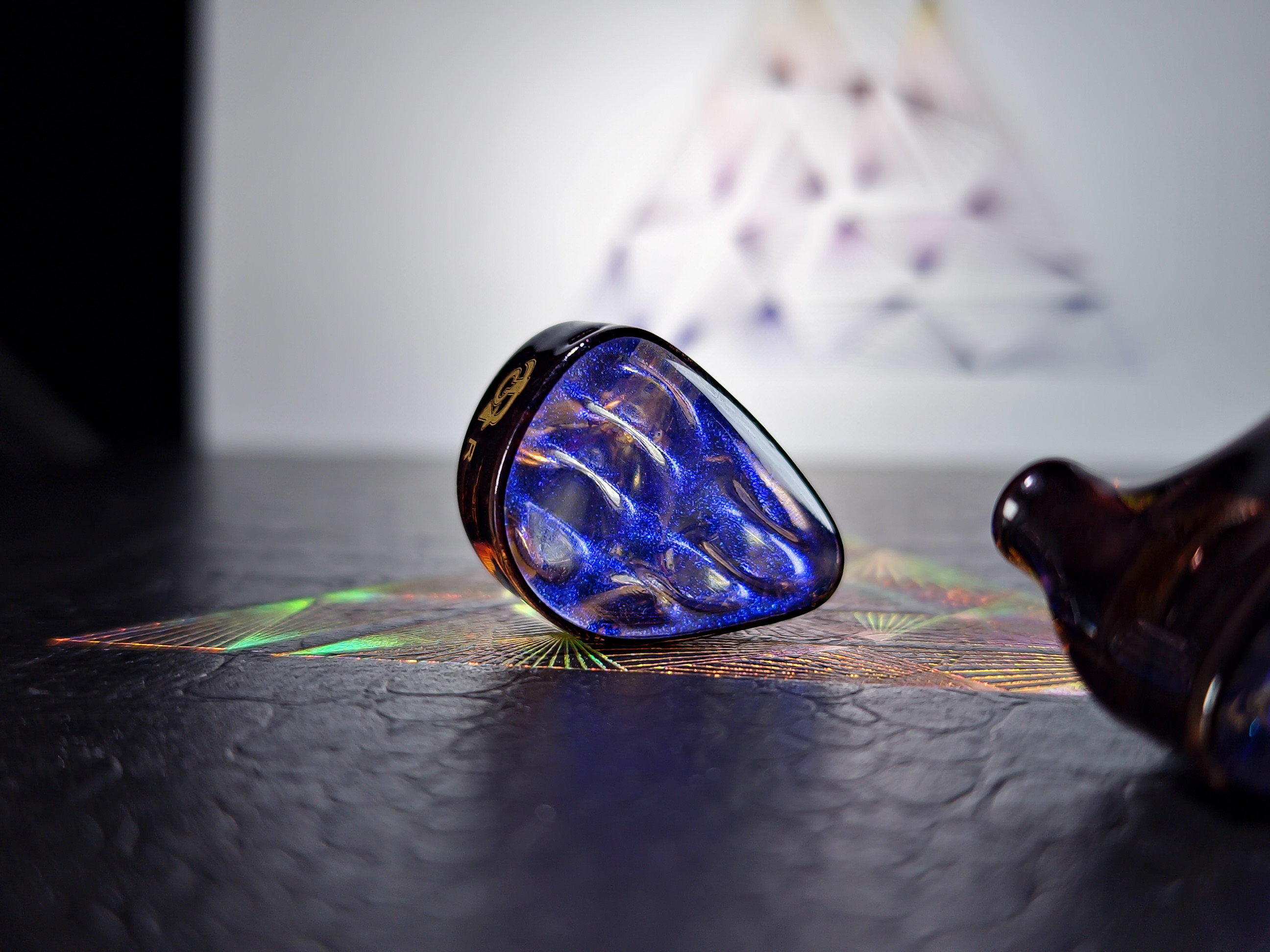
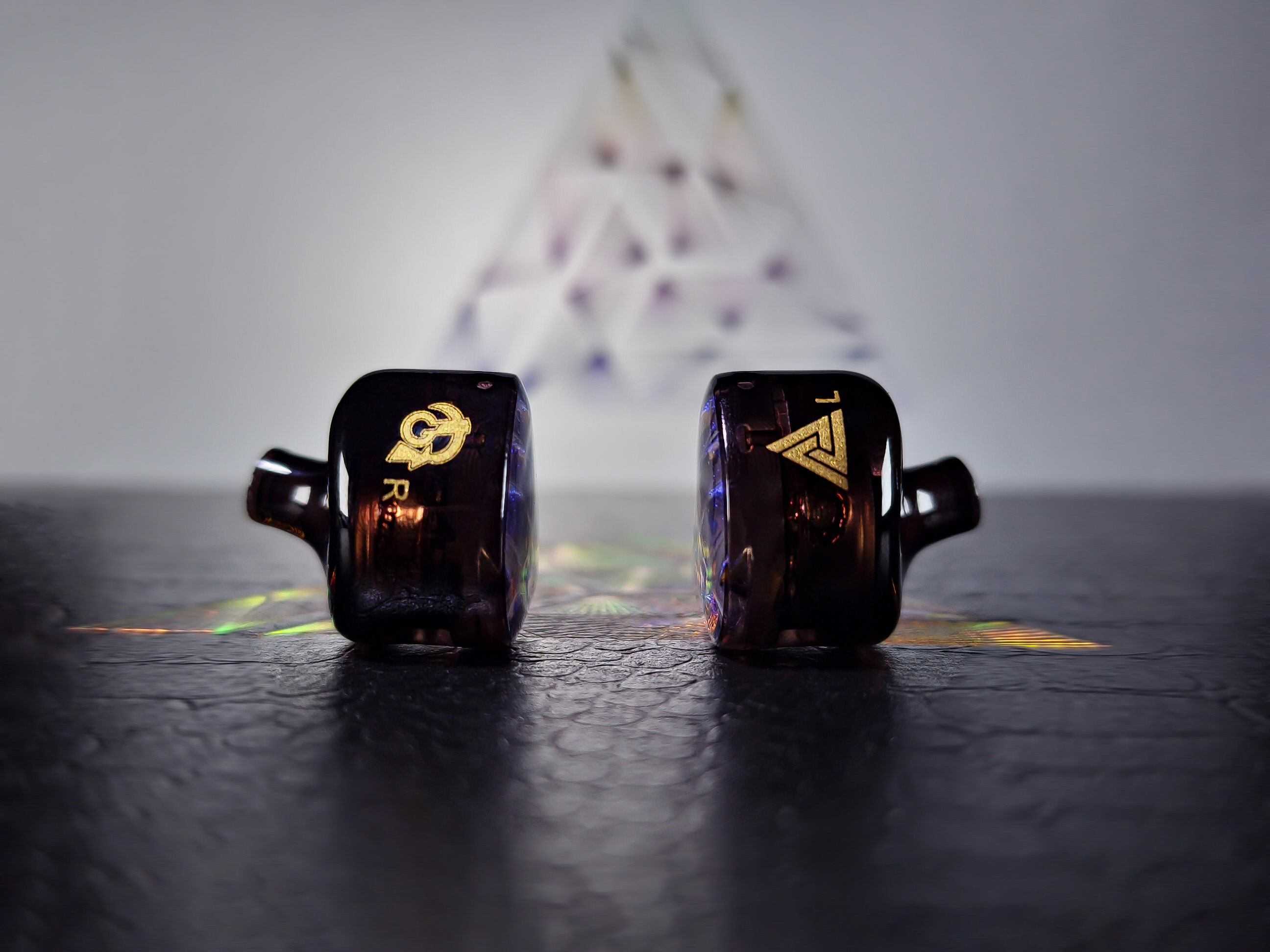
Construction: Starting with the unboxing. I found the presentation very interesting, the experience was really cool, the company invested resources to bring something nice to the consumer, this can be seen as a positive point. Let’s break down step by step the elements that came inside the box. Speaking specifically of the shells, the quality is top-notch. The resin is of great quality, it has a transparency that allows you to see the drivers and also the ducts through which the sound passes. The IEM gained a premium product air with these shells.
Eartips: Only one type of silicone eartips came, in sizes S/M/L. The eartips are good, the interesting thing is that the thickness of the tube is very thin, and this I think is very good because it doesn’t increase the diameter of the IEM nozzle, it becomes something more comfortable to use for long times. In my opinion, I think the unboxing experience was good but maybe it was missing a set of eartips… which is never too much. In the end, I managed to find the sound/fit/comfort with the eartips that came with the IEM, and therefore, I did the review with them (in size M). I see no need to acquire eartips from third-party companies for Hades (of course, this is subjective).
Cable: If the unboxing experience was cool, I can’t say the same about the experience with the cable… in my understanding, it was a negative experience. Given the quality of the shells, this IEM didn’t deserve this cable. It tangles a lot, picks up a bit of memory, a bit of microphonics. The earhooks have a strange curvature, they end up touching the ear right at the end of the plastic… It’s okay it didn’t make a pressure point, but it’s not ideal to be like this. I think the only thing I see as a positive point is that it is a thin and light cable. Hades is really an IEM that can receive a cable upgrade. I know that this is partly subjective but I think something better could have come. The cable doesn’t have a chin slider because it comes with a microphone module.
Fit and comfort: Certainly a very positive point of Hades, both the fit and the comfort, very good. No surprises, the shell is very anatomical, it was 100% stable in my ears, the earphone has a design that is already established for use in IEMs. I found the isolation medium, and the insertion medium. Very comfortable IEM, good for listening for a long time. The only thing that I didn’t really like was the curvature of the earhooks, which didn’t cause me discomfort, but I think it could have a better angle and avoid contact there at the end of the plastic.
Accessories: Here we have two other interesting things. The IEM has a very weird case, and honestly the material is a very bad plastic… I didn’t like it… and even though it’s a rigid case, it made all that luxurious unboxing experience sound like a cheap product. And the other unusual thing about the product is that it comes with a coin – I’m not even sure if I could call it a coin – it has the HBB logo and the QKZ logo. It’s a decorative item, but as always, it’s not usable as an accessory in favor of the IEM… they could have invested in putting a better quality cable, or putting more tips. Anyway, my opinion.




SOUND ASPECTS:
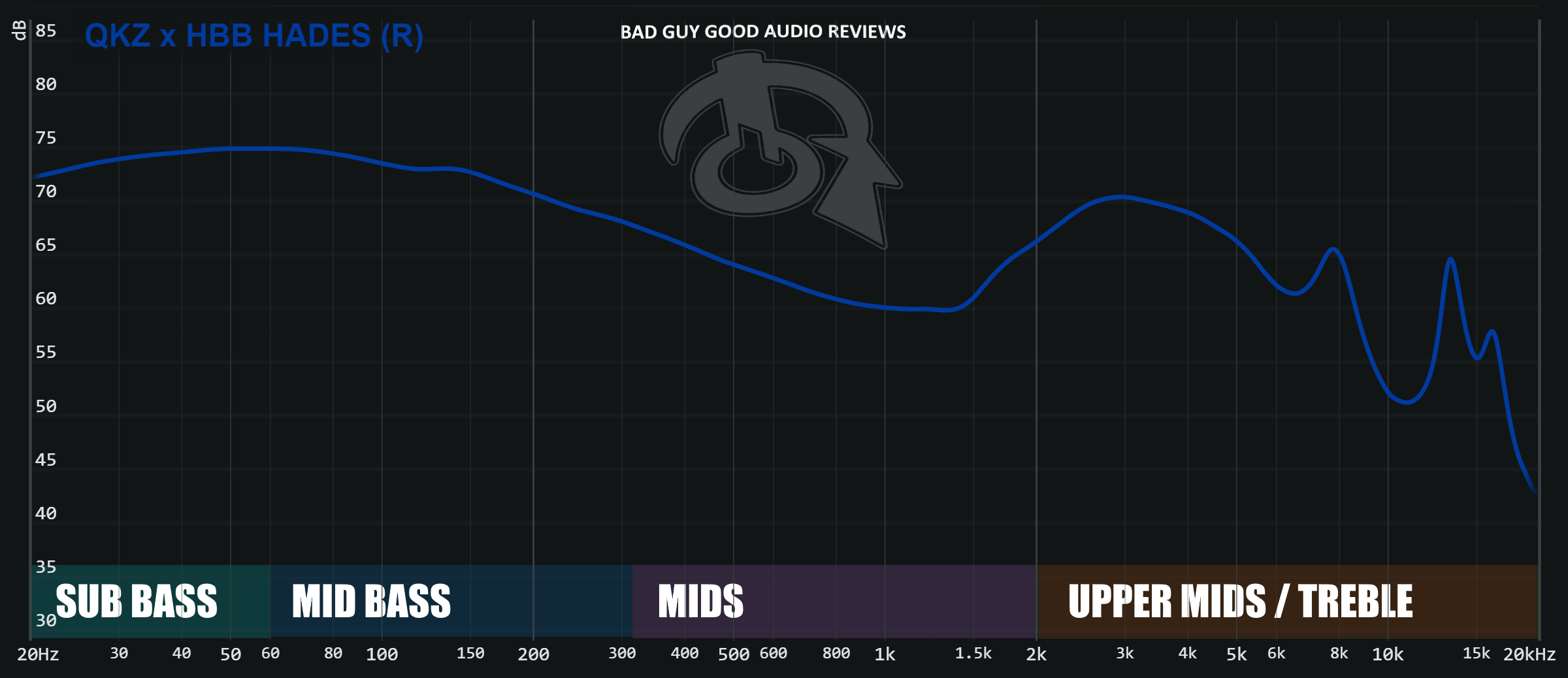
The sound of the QKZ X HBB Hades I understood as a L-Shape IEM. The Hades has a boost in the bass region, and in the mids and treble it sounds more subtle, discreet. I think the main characteristic of this IEM is the sound more geared towards the warm, it ends up entering in the list of dark IEMs. This I think is an IEM recommended for those looking to have a presentation with bass more highlighted than the rest of the frequencies, or also, people who are looking for IEMs with less activity in the treble region.
I did a test with the Moondrop SpringTips and found that it improved the sound more, increased the midrange and a bit of the treble… but still, the IEM remained with prominent bass, and didn’t change the qualitative state of the bass. As I said in the eartips paragraph, I did the review with the stock eartips.
Bass:
Quantitative: Let’s start by talking about the region of greatest highlight in Hades. The level of the bass I understood as high. But calm down that it is also not anything out of this world… yes it has a lot of bass, but I don’t consider that it’s an inaudible IEM because of that. For my taste, it could have less bass, or a better balance between the other regions (mids and treble). It’s an IEM that can serve a person who enjoys bass and who doesn’t enjoy mids and treble more forward. Hades has a lot of sub-bass and mid-bass, and I think that the mid-bass are a little more highlighted in the presentation. I didn’t feel roll-off, the extension is good. Certainly this is an IEM that will go better with genres where the bass need a little more highlight, like Reggae, Hip-Hop, EDM, etc.
Qualitative: They are very strong, massive, they have a lot of weight, body, a lot of physicality, a lot of texture. The impact is very strong and massive, voluminous. They are bass that fill and give a sensation of warmth to the presentation. Unfortunately, all this amount of bass mentioned in the previous paragraph, along with the technical capacity, made the bass sound more expansive, they tend to be bass more inclined to the boomy side, to the muffled side, and end up invading the midrange. It’s not that they are bad definition bass, but for all the other characteristics, they end up sounding more “slow”, “unbalanced”, it’s that kind of bloated bass. If the person doesn’t care so much about technicality, and seeks more quantity, the Hades can be a good choice. In this price range, a heavy competitor for Hades is the Tin HiFi C3. The C3 in my opinion has qualitatively better bass.
Mids:
Quantitative and qualitative: The mids of Hades are recessed, and still has the factor that the bass are in greater quantity, which makes the mids of Hades have less highlight. The mids are at the moderate to low level, and the projection was below what I would like. Technically speaking, it lacks detail, it lacks airy, and it’s far from having a high resolution level. The mids receive strong influence from the bass and have a more “warm” characteristic. The only thing I could say as a positive point here is that certainly these mids will never make anyone feel hearing fatigue. The pinna gain region is very smooth, so, you can listen for hours without getting tired. Inevitably the sound is a whole, and you can’t listen to the mids without listening to the bass (voluminous).
Voices: Easily the male/low voices had more performance. I was listening to the album “Dori Caymmi – Mundo de Dentro (2010)”, and how Dori’s voice becomes deep, textured and imposing here in Hades. On the other hand, the female/high voices lose that energy, vitality, projection, they always have a softness in the presentation.
Treble:
Quantitative: The treble I think are moderate to low. There really is less presence of treble in Hades. If it isn’t a song that has a highlight of some treble instrument, you might not even remember that the IEM has treble. It follows well the line of the mids, which also don’t stand out in the presentation. This is that type of IEM that has zero chances of bothering someone because of treble. Here in Hades I had the sensation of roll-off in the treble, the extension didn’t seem very good. This is undoubtedly not the type of IEM to listen to more detailed genres like Jazz, classical music or instrumental music.
Qualitative: I think they are soft, calm, relaxed treble, without peaks, without coloring, without fatigue. On the other hand, the softness is so much that the IEM loses technical power, the definition is just ok, the sparkle is very contained, it lacks detail, it lacks airy. They aren’t strident treble, they aren’t harsh treble, they aren’t sharp treble, and they didn’t present sibilance at any time. Chime sounds very discreet, the brightness almost doesn’t appear. For my taste, I think that the Tin HiFi C3 can be an IEM that, even with also more contained treble, has a better balance than Hades (not only in the treble but in a general context).
Soundstage: The sensation of soundstage I found medium/good. IEMs with recessed mids usually have a greater depth in the sound, and if the person is not listening to a song with a lot of bass highlight, then I think the presentation becomes with an interesting spatiality… but when the bass is very active, then this sensation is shortened.
Imaging: The instrumental separation I found to be medium to low. The IEM doesn’t have good detail in the mid and treble regions, this caused a very big impact on the perception of the positioning of the instruments. What you can hear more easily are the instruments that transit in the region of the lower frequencies. And even so, it kind of covers the space of other instruments in the presentation. Remember that this issue has a strong influence from the quality of the recording.
Driver flex test: I didn’t heard driver flex sound when inserting the earphones in my ears.
Amplification: I used the DAP FiiO M11S to do this review. The output used was the 3.5mm and the DAP in High Gain mode. The Volume was at 80% of the 120% available by the M11S. I can affirm that Hades is an easy to play IEM, it doesn’t require dedicated amplification. I tested Hades on the FiiO KA11 and it played easily. Hades will play on smartphones, iPads, and notebooks. But as usual, I indicate that at least the person has a good quality dongle to play the IEMs. Currently, I make the recommendation of the FiiO KA11 as a good cost/benefit dongle.


PROS AND CONS:
– Interesting unboxing
– Quality of the shells
– Basshead sound (subjective)
– Hearing fatigue free
– Good fit and comfort
– Light earphone
– Good ear eartips
– Easy to play
– Too much bass (subjective)
– Bass invades the mids
– Recessed mids and treble
– Low detailing
– Low imaging
– Bad cable
– Low-quality carrying case
– Coin?
– Few eartips
GRAPHS BY HBB:

Thank you so much for being here!
Follow us on Instagram to get all the news!
We also have a group on Telegram, let’s talk.

 )
)

 IEMs and Music